Culture of Qym
The culture of Qym or the Qymish culture refers to both the national culture of the Qymish people and regional cultures within Qym. It has mainly been influenced by the Byrakan, Ottelian and Sukat cultures over the history of Qym.
Identity
Qymish people are the main ethnic group and national identity of the inhabitants of Qym. Throughout Qymish history, many regional ethnic groups became Qymish through assimilation, while other groups retained their distinct ethnic identities, such as the Rumykians, the Emadinians, and the Sunamese. Foreign ethnic groups have also migrated to Qym throughout history and in contemporary times, affecting the ethnic composition of the population. Based on modern-day DNA testing, Qymish people are mainly descendants of the Byrakans.
Role of the King
The King of Qym has an integral role in shaping and defining the Qymish national identity. The national motto, Follow the King, reflects that role. U/C
Sociologist DUDE described the Qymish monarchy as a religion. U/C
Languages
Qymish, a Sukatic language, is the sole official language of Qym. Most Qymish vocabulary is derived from the Sukat language. Significant minorities of words are derived from Ottelian and Byrakan, with a smaller amount from OTHER ANCIENT MERANIAN CIV LANGUAGE and NEIGHBORING LANGUAGE. Qymish is written using the Sukatic script.
The creation of the Royal academy of the Qymish language and many other academies in the 21st and 22nd centuries reinforced the unifying role of the Qymish language in culture, often at the expense of regional cultures. Regional languages native to Qym include Rumykian, Emadinian and Sunamese which are also Sukatic languages. Those three languages are recognized by the Regional Languages Royal Decree of 2353, which guarantees access to compulsory education for speakers of those languages.
The Rumykians, the Emadinians, the Sunamese, and other minority ethno-linguistic groups have their own cultures and traditions, although heavily influenced by Qymish culture. Rumykian culture especially is considered more distinct due to belonging to the South Sukatic tradition, while Qymish, Emadinian and Sunamese are all North Sukatic.
Dialects
Humor
Naming conventions
Arts
Literature
Theater
Visual arts
Museums
U/C
Dance
Music
Cinema
Television
Comics
Architecture and housing
Many renown architectural structures in Qym have royal functions, such as the art deco and neoclassical Palace of Zhol, built during the 2320s, 2330s and 2340s, or the gothic, baroque and rococo Palace of Zhifol.
In terms of residential architecture, wall-to-wall row houses, duplexes and triplexes dominate nation-wide in most cities, and generally comprise alleyways and balconies on two to three stories. The staircases of duplexes and triplexes are a unique architectural feature in Qymish cities. Primarily located outside, with a separate entrance at the front, the railings are made of wrought iron and the steps of wood. Their design varies considerably from one building to another. Their origins date back to the mid 22nd century, when urban population increased due to the influx of people from rural areas seeking work. This growth concerned the royal authorities, which adopted a law requiring property owners to maintain a small green space in front of their homes, providing more open space to the streets and neighborhoods. This law led to the design of new housing: narrow, deep apartments on two or three floors, built side-by-side. These are less expensive to heat in winter compared to those with a shared interior space, since the staircase is located outside, above the small green spaces created at the front.
In larger cities and closer to city centers, such as in Zhol, apartment buildings are common and vary in style from wall-to-wall stone or brick tenements above five stories to individual high-rise towers made of concrete or steel and glass. Large-panel-system buildings are common in newer neighborhoods of larger cities, usually built to house low-income tenants.
In rural areas, single-family homes are the norm due to the larger available space and lower demand for housing. Traditional Qymish rural houses are rectangular, single-story structures with high, steep roofs. This roof design serves, among other things, to prevent snow accumulation in winter. Traditional houses are generally built of wood or stone, while modern houses are built in a wood, steel or concrete frame, with brick, stucco, vinyl, aluminium or fibrocement exterior cladding.
Science and technology
Society
Family
Romantic partnerships
Work
Qymish work culture
Etiquette
Greetings
Qymish people do not usually shake hands when greeting strangers, as holding hands in any way or form is considered an intimate practice reserved for loved ones and family. Instead, they lightly bump their fists against one another, a practice popularized through the sport of hockey in the 23rd century. A cursory bow of the head is usually sufficient in more formal situations when meeting strangers, for instance when entering a shop or being formally introduced to someone. When greeting close friends or family members, people hug and kiss once on each cheeks, regardless of gender. Hugging and kissing someone who is only an acquaintance or worse, a stranger, is taboo and may be considered sexual harassment under modern Qymish law.
Eating and drinking
In a typical family meal or among friends, the members gather at a table and sit only when invited to sit by the host. The seating arrangement is also at the discretion of the host and it is considered polite as a guest to ask the host where to sit. Furthermore, guests are not to eat or drink unless given permission by the host while at the table. It is customary to wait for the host and/or cook to sit and finish serving food before then making a toast in their honor or to thank them for the food, after which, and only then, is it allowed to eat.
With the advent of the radio, television and smartphones, technology at the table has raised issues. It is often to the discretion of the people involved, but in general, most Qymish people frown upon people using their smartphone while eating, for any reason besides an emergency situation. Technology use at a table is only allowed when a person is eating alone, for example at a restaurant.
When it comes to paying the bill in a restaurant or elsewhere, gratuity is not expected and is instead considering insulting. It is only allowed in certain circumstances, when returning money would be inconvenient or insignificant, such as when the buyer rounds up the price of their purchase when paying in cash.
Making noise when drinking or eating is considered rude and impolite, particularly chewing with one's mouth open, slurping and burping.
Removal of footwear indoors
In Qym, it is customary to take one's shoes off at the entryway before entering a house. Some households may use indoor slippers, but it is far more common to walk around barefoot or in socks. Entering a house with shoes on is considered a major taboo, as it is synonymous with bringing in outside dirt and snow to one's residence, making it messier. Indeed, in winter, footwear worn outside is often wet from snow and soiled by the associated salt/sand that is used to clear roads and sidewalks of snow cover. Consequently, all schools in Qym require students to bring with them or leave behind a pair of "indoor shoes" at the school for indoor wear during the winter months. The same rules are applied in gyms, offices, and other establishments during the winter months. During other seasonal periods, it is common to wear outdoor shoes to school or work. An exception to this are public places like restaurants and stores, where it is not expected for clients to remove their shoes, regardless of the season and snow coverage. That is because these businesses are usually equipped with hard floors that are easy to clean or carpets designed to absorb melted snow.
Funerals
As a predominantly Scildist country, Qymish funeral traditions are similar to the rest of Meran. U/C
Directness
Qymish people are very direct and do not shy away from confrontation. U/C
Pets
Like elsewhere on Basis, cats and dogs are the most common pets owned by Qymish people. U/C
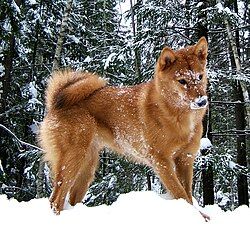
Common dog breeds originating from Qym include the Mudi, Roduvas, and the Vusat. Similarly, common Qymish cat breeds include the Sandy cat, Nagurian Blue, and Snowshoe cat.
- Dog and cat breeds from Qym
-

-
-

-

-

-


.jpg)
Leisure and hobbies
Vacation
Video games
Fashion
Traditional clothes
Modern fashion
Zhol is one of the fashion centers on Basis. U/C
Cuisine
Sports
The most popular one in terms of spectators is ice hockey, commonly referred simply as "hockey" (ⱝⱁⰽⰺ hoky). Ice hockey is native to Qym and considered its national sport.